


[INDICE:h2]
Combination skin is almost always described as "two skins on the same face": oily in the center, normal or dry on the sides. This simplification leads directly to the most common mistake: creating two separate routines and applying them to different areas.
In reality, there are not two skins. There is one skin, with sebaceous glands distributed unevenly. The forehead, nose, and chin have a much higher density of them than the cheeks and the area around the face: this is anatomy, it applies to everyone, and in some people the difference is pronounced enough to become visible.
Combination skin should not be treated by zones, but according to priorities. Use a single routine designed for the most fragile part of the face, with one or two targeted steps where sebum is concentrated. People who use two different products on two halves of the face usually make both areas worse.
What really distinguishes combination skin
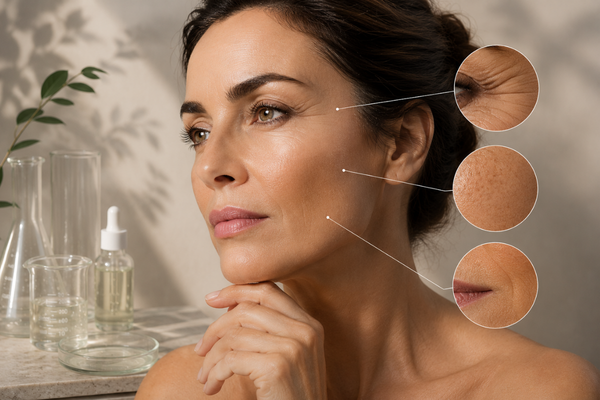
The criterion is not shine itself, but the difference between areas. With combination skin, the central area of the face produces more sebum, has more enlarged pores, and tends to develop blackheads, while the rest of the face has normal or low sebum production and may feel dry.
The distinction from other skin types is explained in the general article on different skin types. If the shine is spread across the entire face, however, it is not combination skin but oily skin, and the routine changes.
The most common false positive
Many people who are convinced they have combination skin actually have dehydrated skin that reacts by producing more sebum wherever it can, namely in the central area. The pattern is recognizable: a shiny nose by mid-morning, tight-feeling cheeks, and above all a clear worsening after harsh cleansers or overly frequent exfoliation.
The difference is substantial, because in this case the problem is not sebum but water: the distinction between dry and dehydrated skin applies here too. Before setting up a combination-skin routine, it is worth ruling out this possibility, because the two approaches are almost opposites.
How to tell them apart in one week
- For seven days: gentle cleanser, a lightweight moisturizer morning and evening, sunscreen, nothing else.
- No exfoliant, no clay mask, no mattifying product.
- If by the seventh day the central area is less shiny and the cheeks no longer feel tight, it was dehydration.
- If the difference between the areas remains the same, it is combination skin.
The routine, in the right order
Cleansing: once, gently
Choose your cleanser based on the most fragile area, not the oiliest one. An aggressive surfactant cleans the nose well but leaves the cheeks feeling tight, and the central area's response to a weakened barrier is to produce more sebum.
In the evening, if you wear makeup or water-resistant sunscreen, double cleansing is the way to remove everything without making the cleanser more aggressive.

CLEANSING DETOX MOUSSE Detoxifying facial cleansing mousse Remove makeup and any trace of impurities Respect the skin's balance Brightens a... Discover CLEANSING DETOX MOUSSE
Exfoliation: once or twice a week, all over the face
The mistake here is exfoliating only the T-zone, and doing so more often. The result is a face with one irritated area and the rest unchanged. Due to its molecular size, mandelic acid penetrates more slowly and is better tolerated by more reactive areas; salicylic acid, on the other hand, is lipophilic and works inside the pore, so it makes sense where blackheads are the main problem.

MANDELIC ENZYMATIC SOFT PEEL Delicate face scrub of high tolerance, stimulates cell turnover Cell turnover stimulation Regenerating action Fades ... Discover MANDELIC ENZYMATIC SOFT PEEL
Hydration: lightweight, but all over
Skipping moisturizer on the central area because it is “already oily” is what keeps the problem going for years. Sebum is not water: an area can be both shiny and dehydrated at the same time. You need a lightweight texture applied everywhere, possibly with a second, richer layer only on the cheeks during the colder months.

NUTRALIGHT SENSITIVE Soothing and repairing face cream with thermal water from the Piedmont Alps – ideal for sensitive and reactive skin ... Discover NUTRALIGHT SENSITIVE
The targeted approach: only here does it make sense to treat areas differently
A clay mask applied once a week only to the central area is the only localized treatment that truly makes sense for combination skin. It absorbs excess sebum where it builds up without affecting the rest of the face.

SKINPURE REBALANCE Purifying Green Clay face mask for oily and impure skin based on Potassium Azeloyl Diglycinate, Zinc PCA, Green Clay... Discover SKINPURE REBALANCE
Sun protection, all year round
Combination skin tends to reject sunscreens because of their texture, which is why many otherwise correct routines stop here. A fluid formula improves adherence to the routine more than any other technical detail.

SPOT DEFENCE 50 SPF Anti-spot face sunscreen serum SPF 50 with encapsulated vitamin C and probiotic ferments for skin with discolorations... Discover SPOT DEFENCE 50 SPF
Treatments designed for this balance are collected in the skincare for combination skin collection.
The four mistakes I see most often
- Two separate routines: this doubles the number of products, makes consistency more difficult, and does not solve the problem, because sebum does not stop at the boundary we have drawn ourselves.
- Choosing a cleanser based on the oiliest area: this depletes the barrier elsewhere on the face and increases sebum production in response.
- No moisturizer where the skin shines: this is the most common cause of the shiny-dry vicious cycle.
- Clay all over the face: a purifying mask is a localized treatment, not a cream.
When combination skin changes over time
Sebum distribution is not fixed. It changes with the seasons, hormonal fluctuations, and age: after thirty-five to forty, many combination skin types shift toward normal or dry, and the routine needs to be revised. When the first signs appear on skin that still produces sebum, the criteria for choosing active ingredients differ from those for dry skin: I wrote about this in first wrinkles on combination or oily skin.
There is also the nervous component, which affects combination skin more than you might think, because the sebaceous glands also respond to stress signals: this approach is described in skincare for combination skin and neurocosmetics.
Frequently asked questions
Can I use two different creams on two areas of my face?
You can, but it is almost never necessary. A light base over the entire face is better and, if the cheeks still feel uncomfortable, a second, more nourishing layer just there. It is simpler and holds up over time.
Should facial oils be avoided?
No, it depends on the oil. Some are well tolerated even by skin that produces sebum: the selection is in facial oil for oily skin.
Does a shiny T-zone mean impure skin?
Not necessarily. Excess sebum is one of the factors that contribute to comedones, but it is not enough on its own. If the pores appear clogged and the skin texture thickened, it may be asphyxiated skin.
How often should the routine be reviewed?
Twice a year, when the seasons change. Combination skin is the type most affected by humidity and temperature.
Sources for this article
- Youn SW, Na JI, Choi SY et al. Regional and seasonal variations in facial sebum secretions. Skin Research and Technology, 2005.
- Zouboulis CC. Sebaceous gland receptors. Dermato-Endocrinology, 2009.
- Draelos ZD. The science behind skin care: moisturizers. Journal of Cosmetic Dermatology, 2018.
- Proksch E, Brandner JM, Jensen JM. The skin: an indispensable barrier. Experimental Dermatology, 2008.
On the website: skincare for combination skin · treatments for oily skin · hydrating facial treatments
Elisa Avalle is the founder of LeLang Skin Care, specializing in dermocosmetics at the University of Barcelona