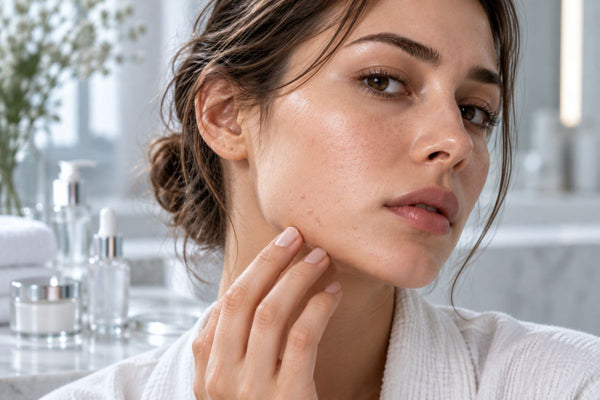



Shower gel, bubble bath, and docciaschiuma are the same thing. Shower gel is the English term, docciaschiuma is the literal translation, and bagnoschiuma is the term that has been used in Italy for the longest, originating when bathing, rather than showering, was the daily routine. None of the three indicates a different formula.
The point is that the word on the label says nothing about how the product will treat your skin. Two bubble baths with the same name can behave in opposite ways, and what makes the difference are three things that are almost never stated on the main label: the cleansing base, the pH, and the presence of emollients.
Article written by Elisa Avalle, founder of LeLang Skin Care and a dermocosmetics specialist. Cover image generated with the support of artificial intelligence.
[INDICE:h2]
Why there are three names for the same product
It is a matter of language and marketing, not formulation.
- Bagnoschiuma originated when people washed in the bathtub: the product had to create foam in the water.
- Docciaschiuma is the Italian adaptation for showering, which replaced bathing in the daily routine.
- Shower gel is the English term, introduced in Italy by international brands. The term "gel" indicates, at most, a thicker, more transparent texture, but it is not a requirement: many products called shower gels have the same consistency as those called bubble baths.
There is also bath cream or shower cream, which usually indicates a richer, more opaque texture. Here too, however, the name is a marketing promise, not a regulated category.
What really differs from one body cleanser to another
If the names are not helpful, three elements are. They also explain why one product leaves your skin feeling tight while another does not.
The cleansing base
It is the core of the formula and appears near the top of the INCI list, after water. Surfactants vary greatly in how harsh they are: some cleanse deeply and produce a lot of foam but also remove some of the skin's surface lipids, while others are gentler and produce more modest foam. The amount of foam is not an indicator of cleansing: it indicates how accustomed we are to associating foam with cleanliness.
The pH
It is the most underestimated criterion. The natural pH of the skin's surface is acidic: a multicenter study of 330 volunteers estimated it at an average of around 4,7. That slight degree of acidity is not a minor detail; it supports the resident flora and the barrier function.
A traditional soap, on the other hand, has an alkaline pH, often between 9 and 10. This is not a flaw in the soap; it is its chemistry: that is how it is made. But on skin that already feels tight, using a highly alkaline cleanser every day moves the skin's pH away from its usual level, and it takes time to return. This is why modern cleansers for sensitive skin are formulated within a range closer to that of the skin. If you want the full picture, I discuss it in greater detail in the article on the skin's pH.
Emollients
They are the part that remains on your skin after rinsing. A cleanser designed only to wash leaves the skin clean and bare; one containing an emollient component leaves a veil that makes up for what washing has removed. It is the difference you feel in the ten minutes after the shower, not during it.
Shower gel, cream, or oil: the difference you can feel
Here the distinction is real because it concerns texture and therefore how the product behaves on the skin.
- Gel: transparent and refreshing, it rinses off quickly and leaves little behind. It works well for normal skin, in summer, and after exercise.
- Shower cream: opaque, with a higher lipid content, it leaves the skin softer. It is a sensible choice in winter and for skin that feels tight.
- Shower oil: it transforms on contact with water and leaves the most substantial film of the three. Useful for very dry skin, although not everyone likes the feel.
One thing needs to be clear: a body cleanser improves the skin's comfort, softness, and appearance. It does not treat dermatitis, eczema, or psoriasis. If your skin is persistently itchy, flaky, or red, a dermatologist is the right point of reference, and choosing a cleanser becomes part of the process, not the solution.
The mistake almost everyone makes in the shower
Before changing products, it is worth looking at your technique, because the culprit is often not the body wash.
- Water that is too hot. It is the most common cause of tight-feeling skin, and it matters more than the cleanser itself: it dissolves surface lipids much more effectively than any gentle surfactant. Use lukewarm water, not hot.
- Long showers. Contact time matters. Ten minutes under hot water does more harm than a mediocre product used for three.
- Too much product. A walnut-sized amount is enough. The rest is foam that ends up down the drain.
- Using a harsh sponge every day. Daily mechanical exfoliation is too much: once or twice a week is enough for the body, and I discuss it in how to exfoliate the skin.
- Rubbing yourself dry. Pat your skin dry. Apply body cream while your skin is still slightly damp, not when it has been dry for ten minutes.
How to choose based on your skin
There is no universally best cleanser: there is only one that suits how your skin reacts after a shower.
- If your skin feels tight in the minutes afterward: you need a gentler base and an emollient component. This is a sign that the hydrolipidic film is being removed faster than the skin can rebuild it. This is the same issue as the difference between dry and dehydrated skin.
- If your skin becomes red or itchy: check the fragrance and surfactants. On sensitive skin, cleanser is the product that stays on the skin for the shortest time but touches it every day, so it matters.
- If your skin is normal in summer: a lightweight gel is enough; nothing else is needed.
- If your skin is very dry in winter: shower cream or oil, followed by body cream.
You can view all the body formulas in the body skincare collection.
LeLang Body Cleansing
Relax Shower Gel belongs to the Essentia Spa line and is formulated with a gentle cleansing base and an emollient component that remains after rinsing. It contains neurocosmetic active ingredients, a field that studies the dialogue between the skin and the nervous system: for the body, the focus is on improving skin comfort and the perception of the ritual, not just cleansing.

RELAX SHOWER GEL Moisturizing shower gel for sensitive skin Shower gel with neurocosmetics, for a shower that relaxes skin and mind. ... Discover RELAX SHOWER GEL
The next step matters just as much as the cleanser: body cream applied to still-damp skin retains water instead of merely covering it.

RELAX BODY CREAM Relaxing moisturizing body cream With neurocosmetics and 4 hyaluronic acids, for soothed and nourished skin. Multi-l... Discover RELAX BODY CREAM
If you are not sure which texture you need, the quickest way to find out is to try it: at LeLang partner pharmacies, the pharmacist can let you feel the difference between a gel and a shower cream on your hand, which is a criterion no online description can replace.
Frequently asked questions
Are shower gel and body wash the same thing?
Yes. They are two names for the same type of product: a liquid body cleanser to use in the shower or bath. Shower gel is the English term, while bagnoschiuma is the Italian term. The name does not indicate a different formula or a different quality.
What is the difference between body wash and soap?
True soap, the kind produced through saponification, has an alkaline pH, generally between 9 and 10. Body wash is made with synthetic surfactants and can be formulated at a pH closer to that of the skin. On skin that tends to dry out, the difference is noticeable; on resilient skin, much less so.
Should body wash be used every day?
If it is gentle, yes, but you do not need to use it all over your body every time. The areas that really require it are few: underarms, feet, groin, and the parts exposed during the day. On your legs and arms, especially in winter, water is often enough.
Why does my skin feel tight after showering?
In order: water that is too hot, showers that are too long, cleanser that is too harsh, no moisturizer afterward. In most cases, the cause is the first, not the third. Try lowering the temperature for a week before changing products: it is free and often solves the problem.
Is lather an indicator of quality?
No. The lather depends on the type of surfactant and how much was added to meet a sensory expectation. Many gentle cleansers produce little lather and wash perfectly. It is a perceptual habit, not a technical fact.
Do you need an acidic-pH body wash?
It makes sense for sensitive, dry, or itch-prone skin. For normal skin, the benefit is subtler, because healthy skin returns to its usual pH within a reasonable amount of time. It becomes important when the barrier is already compromised, as I explain in the article on the skin barrier.
In conclusion
Shower gel, bubble bath, and body wash are all the same thing, and knowing which word appears on the packaging doesn't tell you anything useful. What is worth looking at is how your skin reacts in the ten minutes after your shower: if it feels comfortable, the product is right; if it feels tight, something needs to change, and not necessarily the cleanser.
15-Minute Free Consultation with the Founder
Does the skin on your body feel tight or become red, and you don't know whether it's due to your cleanser or your routine? Book a free virtual skincare consultation with Elisa Avalle, founder of LeLang.
Sources for this article
01 Lambers H., Piessens S., Bloem A., Pronk H., Finkel P., "Natural skin surface pH is on average below 5, which is beneficial for its resident flora", International Journal of Cosmetic Science, vol. 28 no. 5, 2006, pp. 359-370. Multicenter study of 330 volunteers: surface pH was estimated to average around 4.7
02 Korting H.C., Braun-Falco O., "The effect of detergents on skin pH and its consequences", Clinics in Dermatology, vol. 14 no. 1, 1996, pp. 23-27
03 Regulation (EC) No. 1223/2009 on cosmetic products and Regulation (EU) No. 655/2013 on common criteria for claims relating to cosmetic products: a cosmetic cleanser may improve the appearance and comfort of the skin, but not treat conditions of medical relevance
04 The guidance on water temperature, shower duration, and applying cream to damp skin is based on formulation practice and in-store consultation, not on a controlled clinical study
On the website: body skincare · skin pH · skin barrier · dry or dehydrated skin · sensitive skin · exfoliate the skin · partner pharmacies